Dr Helena Rapp Wright
ECG Bulletin July 2023
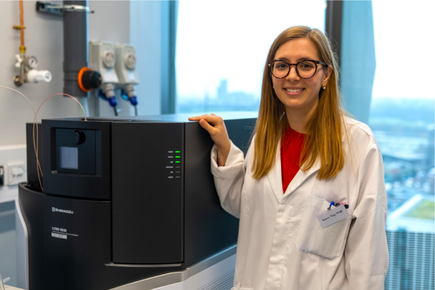
Helena completed her PhD degree at Dublin City University (Ireland) in the School of Chemical Sciences in October 2021. Since then, Helena has been a Research Associate at Imperial College London (UK). Her research focuses on analytical and environmental chemistry, with expertise in contaminants of emerging concern and water analysis.
What inspired you to become a scientist?
I always enjoyed science in school. I remember the first time we visited a laboratory when I was in primary school – that set my mind early; it’s the reason why I studied a chemistry degree.
Also, when I was a kid, I loved watching series such as “CSI”, and I was really determined to work in a laboratory! Years later, I graduated from King’s College London (KCL) with an MRes in Forensic Science.
What inspired you to become a scientist?
I always enjoyed science in school. I remember the first time we visited a laboratory when I was in primary school – that set my mind early; it’s the reason why I studied a chemistry degree.
Also, when I was a kid, I loved watching series such as “CSI”, and I was really determined to work in a laboratory! Years later, I graduated from King’s College London (KCL) with an MRes in Forensic Science.
|
How did you come to specialise in water pollution?
During my MRes, I conducted a research project on how to detect and quantify trace organic explosives from wastewater samples; this acted as an early-warning sign for catchment areas in which explosives might be illegally manufactured, and led to my first publication. I enjoyed it so much, I knew I wanted to stay in water research. Later, I secured a PhD on different chemical contaminants in water, assessing environmental risk in different geographical locations. |
|
Could you describe your current job?
Being a Research Associate allows me to explore different areas; from more environmental projects to public health, including determining contaminants in drinking water as an exposure route to humans. I collect samples and analyse them using different analytical techniques like LC-MS/MS, most of which I develop myself. I engage with different stakeholders and the public community.
What advice would you give to anyone considering a career in environmental chemistry?
Try different topics and get experience in different environments! Environmental chemistry has a broad set of applications; once you know the basics, you can move around the field easily, giving you opportunities to try different research and never get bored! I worked at the drug development services department of a company for two years between my Masters and PhD, and now I work at the School of Public Health.
What are some of the challenges facing the environmental chemistry community?
Public engagement. It is hard to get the public interested in pollution work, without alarming them. Most sources usually have chemicals in really low concentrations (like a spoon of sugar in a swimming pool).
While we shouldn’t panic, we should also not ignore that these chemicals exist, as they may have negative impacts on the environment or our health.
What is the most rewarding aspect of your career so far?
When the public or a specific community are interested in your work and even volunteer to take part in a project, helping make a difference towards sustainability and a better environment in the future.
If you weren’t a scientist, what would you do?
I can’t think of anything else. I really enjoy what I do, but I guess I could have been a vet, as I love animals – or maybe an environmental lawyer!
And what do you do when you are not working?
I love travelling and getting to know other cultures. I have currently visited 44 countries, and aim to reach 50 over the next few years! I also love food and trying new London restaurants (there is always a new place to go!).
Being a Research Associate allows me to explore different areas; from more environmental projects to public health, including determining contaminants in drinking water as an exposure route to humans. I collect samples and analyse them using different analytical techniques like LC-MS/MS, most of which I develop myself. I engage with different stakeholders and the public community.
What advice would you give to anyone considering a career in environmental chemistry?
Try different topics and get experience in different environments! Environmental chemistry has a broad set of applications; once you know the basics, you can move around the field easily, giving you opportunities to try different research and never get bored! I worked at the drug development services department of a company for two years between my Masters and PhD, and now I work at the School of Public Health.
What are some of the challenges facing the environmental chemistry community?
Public engagement. It is hard to get the public interested in pollution work, without alarming them. Most sources usually have chemicals in really low concentrations (like a spoon of sugar in a swimming pool).
While we shouldn’t panic, we should also not ignore that these chemicals exist, as they may have negative impacts on the environment or our health.
What is the most rewarding aspect of your career so far?
When the public or a specific community are interested in your work and even volunteer to take part in a project, helping make a difference towards sustainability and a better environment in the future.
If you weren’t a scientist, what would you do?
I can’t think of anything else. I really enjoy what I do, but I guess I could have been a vet, as I love animals – or maybe an environmental lawyer!
And what do you do when you are not working?
I love travelling and getting to know other cultures. I have currently visited 44 countries, and aim to reach 50 over the next few years! I also love food and trying new London restaurants (there is always a new place to go!).